All platform pages

Data Depth

Most tools record your position. We record the whole SERP.

Nozzle parses 630 fields from every result on the page, not just the ones that are yours: Pixels From Top and Above the Fold % for every listing, every SERP feature from AI Overviews to product packs, who owns each result, and what it's worth in Estimated Traffic. Every SERP is kept forever, raw HTML included, and lands in BigQuery ready to query.

Start Free Trial

One search for "best camping burner" on desktop, Sep 27, 2025: five pages, 23,932 px, 74 results from 54 sites, and Nozzle stored every one. At Rank 56 on page 4, 18,432 px down, sat a site nobody tracked. Through Dec 5 it was on page 4 on 53 of 70 days, with 0 estimated visits; on Dec 6 it was Rank 3, and on Dec 17 #1, which it held on 173 days through Aug 31, 2026. The old #1 sank to Rank 50, on page 4, by Jan 11, 2026.

Film · 40 s

The site that went on to rank #1 on 173 days sat at Rank 56, on page 4, for ten weeks. Only a record of every result had it.

630

Fields parsed from every result

Forever

Every SERP retained, raw HTML included

BigQuery

Native access, plus API, S3, and Snowflake

50-60

Results per SERP, five pages deep

Why teams use it

What 630 fields let you see that a single rank cannot.

01

Measure what searchers actually see, in pixels

Rank does not tell the whole story. Ads and large SERP features can push a listing halfway down the page while its rank never moves. Nozzle measures Pixels From Top, Above the Fold %, and SERP % for every result. Below, the same listing holds rank 3 for two weeks while a sponsored result lands above it and pushes it below the fold. Only pixel data shows that it happened, and what it cost.

Put any two dates side by side in Nozzle Vision
Two Google results pages for the same search, two weeks apart. The same organic listing holds rank 3 on both, but a sponsored result above it on the second date pushes it from above the fold to below it, and its Estimated Traffic falls from 302 to 39.
MetricAug 11, 2026Aug 27, 2026
Rank33
Pixels From Top5311,253
Above the Fold %9.0%0.0%
Click Through Rate10.44%1.36%
Estimated Traffic30239

02

Rank, Base Rank, and Item Rank tell three different stories

Rank counts every result on the page: AI Overviews, People Also Ask boxes, image and video packs, and the organic listings between them. Base Rank counts only the traditional organic listings and featured snippets. Item Rank is your position inside a feature: the third question in a People Also Ask box, or the first source an AI Overview cites. Below, one WebMD page appears twice: first source in the AI Overview at rank 1, and the organic listing at rank 2 and base rank 1.

A Google results page for the search "do fat burners work" beneath a table of its results with Rank and Item Rank columns. An AI Overview at rank 1 cites a WebMD page as its first source. The same WebMD page is the first organic listing at rank 2. A People also ask box at rank 3 holds four questions counting item rank 1 to 4.
MetricRankBase RankItem Rank
AI Overview source, WebMD1n/a1
Organic listing, WebMD210
People also ask, first question3n/a1

03

Model the clicks, not just the position

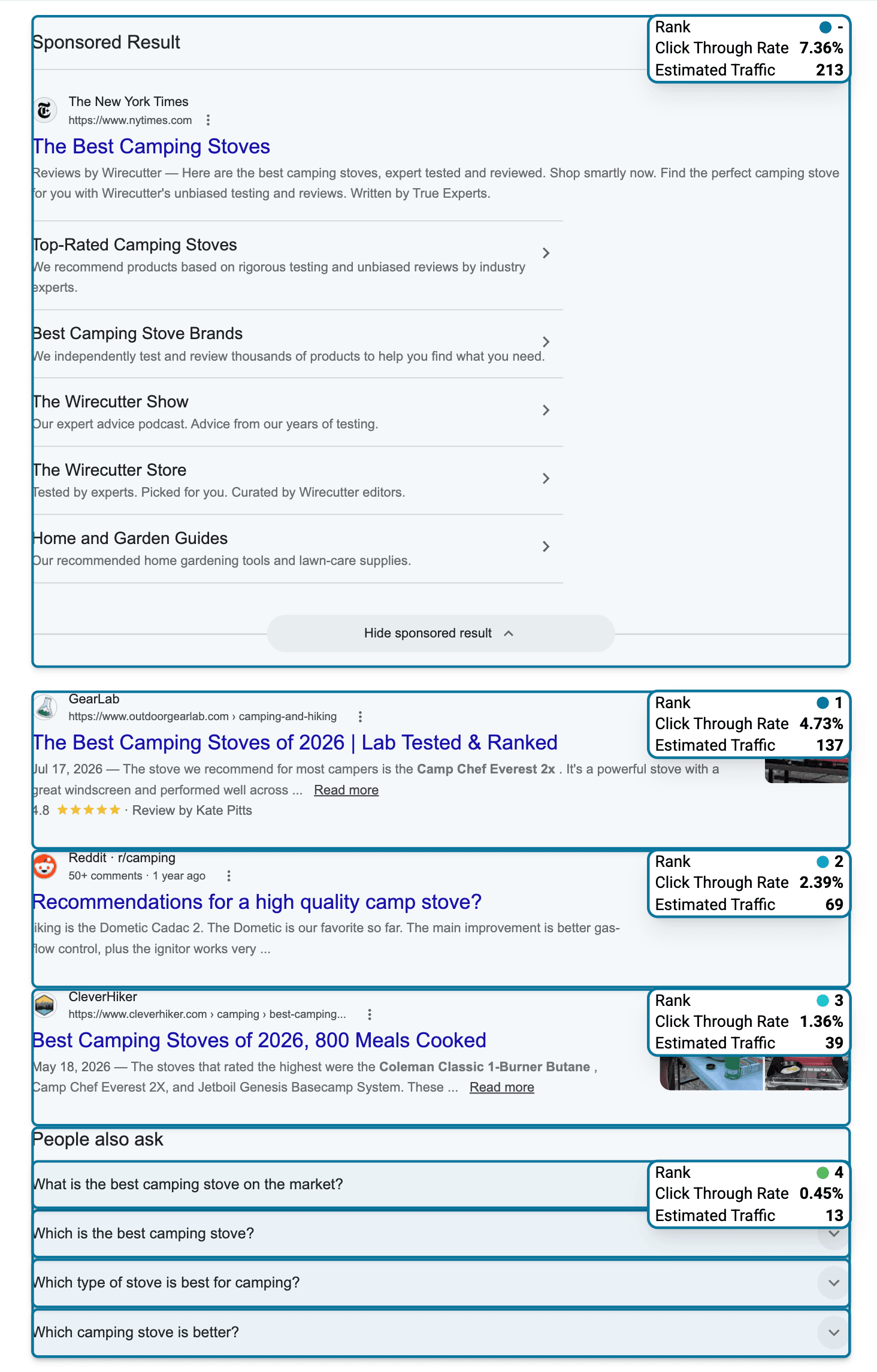
Position does not tell you what traffic to expect, so Nozzle models Click Through Rate per SERP instead of reading it off a generic curve. Every result on the page gets its own Click Through Rate and Estimated Traffic, ads and SERP features included, and when an ad or an AI Overview lands above you, the numbers move with it. Below, the sponsored result at the top of the page is modelled to take more clicks than the listing at rank 1.

How Nozzle calculates CTR
The top of a Google results page for "best camping stove" with Nozzle Vision showing Rank, Click Through Rate, and Estimated Traffic on each result. A sponsored result from The New York Times sits above three organic listings from GearLab, Reddit, and CleverHiker, followed by a People also ask box with four questions.
MetricClick Through RateEstimated Traffic
Sponsored result7.36%213
GearLab, rank 14.73%137
Reddit, rank 22.39%69
CleverHiker, rank 31.36%39
People also ask, first question0.45%13

04

Answer the questions a ranking report cannot

Which merchants keep showing up in the product packs on your terms. Which YouTube channels dominate the video packs across your keyword set. How Google renders your name, address, and phone in local results. Which sources an AI Overview cites, and in what order. Every result type is parsed into its own typed fields, and every field can be segmented, so each of those is a query rather than a research project.

Everything about AI Overviews on your queries
A Nozzle SERP results table for the search "best foam plyo box" with Result Type, Displayed Title, Rank, Item Rank, Merchant Name, Price, Account, and Upload Date columns. The AI Overview's citations carry item ranks, three videos carry YouTube channel names and upload dates, and five product pack items carry merchant names and prices, so each result type fills the columns that belong to it.

05

Every SERP is kept forever, raw HTML included

Nothing is ever deleted. Every SERP Nozzle has collected for you is still there, the 630 parsed fields and the raw HTML behind them, so the SERP from 2020 sits next to this month's, with every year in between. It all lands in BigQuery at no extra cost, with the REST API included and S3 or Snowflake delivery for teams that want it in their own warehouse.

How data teams put it to work
Seven mobile Google results pages for "best camping stove" side by side, one from December 1 of each year from 2020 to 2025 and one from September 1, 2026, each re-rendered from the HTML Nozzle stored on that date. The layout shifts from blue links and a product carousel to sponsored grids, filter chips, and an AI Overview at the top.

Common workflows

Go deeper on what the fields are for.

Product packs and merchants

Which merchants own the product packs on your category terms, and where your items rank inside them.

See the Ecommerce solution

Ready to explore

Stop reporting a number that hides the page

Get every result, every feature, and every competitor on the SERPs you care about, measured in pixels, typed field by field, and delivered somewhere you can actually query it.