Google Killing Incognito Searches?
By Derek Perkins

A signed-out search in an incognito window meets Google’s “Sign in to continue” page on its first search, as first filmed on November 16, 2026. On November 18, SERPs delivered to Nozzle fell to 1.6% of a normal hour at their low, a fall of 98%, and came to 11.6% of normal from 13:00 to 23:00 UTC; each of the five providers we collect through fell to 2% or less of its own normal in its worst hour. Our requests met a CAPTCHA, which can be solved, a delay, which can be waited out, and the wall, which can be neither. Google ships a change like this in steps, 1%, then 10%, then 100%, as it did with /goto links and the end of num=100; the sign-in wall has taken two steps and not the third. The film gives our read of why, that the target is AI assistants and rank trackers are caught with them, and answers whether rank tracking is dead: no.
Contents
In August, Barry Schwartz reported the first known case of Google requiring a login to search, where before it had only used CAPTCHAs to limit use. On November 16, Brodie Clark hit the same wall on his first search, and many others reproduced it. Two days later, for about ten hours, our SERP collection fell by as much as 98% across every provider we use. I think Google is at a crossroads: deciding whether it is willing to forgo revenue from logged-out users in exchange for locking AI competitors out of its index.
What Does This Look Like?
The page says "Sign in to continue", and under that, "Sign in to verify you're a human and see more results." There is one button, and it does not lead to the results. Brodie, who runs SERPalerts, posted a video of it:
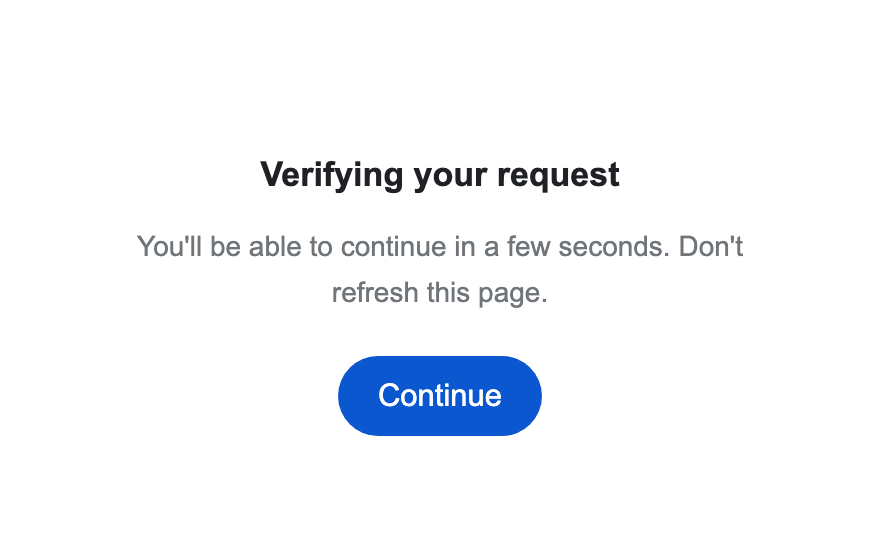
Google also added a similar delay screen at the end of August, which Barry reported. Like goto link resolution requiring exponential delays, this is clearly targeting bots and making it more expensive to scrape.
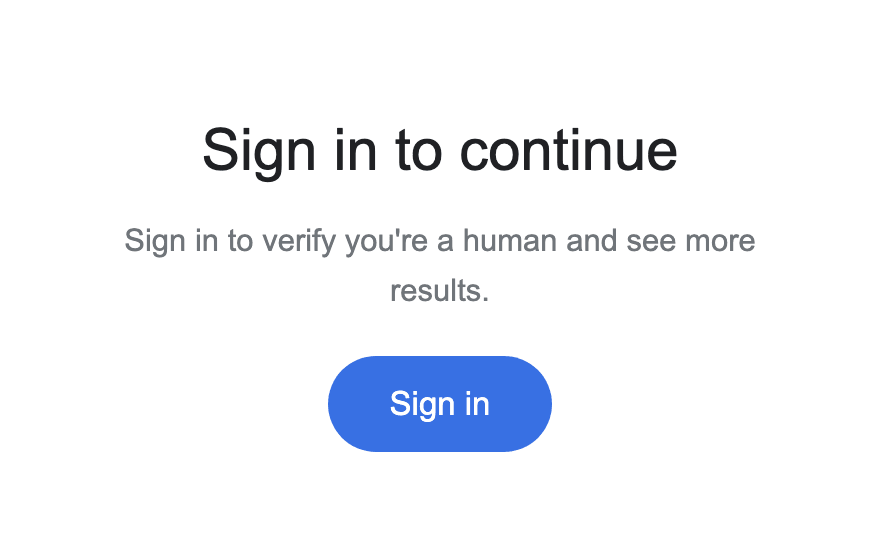
What is new is where the wall sits: on the first search, in incognito, with no way around it. Google's VP of Engineering for Search, Rajan Patel, replied the next day:
Barry Schwartz wrote it up on November 17, in Search Engine Roundtable and on X:
The same day, at 14:10 UTC, SerpApi opened a status incident for slower responses and a lower success rate across its Google APIs. Our own collection looked normal on the 17th. It did not on the 18th.
November 18: A Ten-Hour Test
We collect SERPs through several providers to de-risk, especially as Google is cracking down. On November 18 all of them had the same bad day.
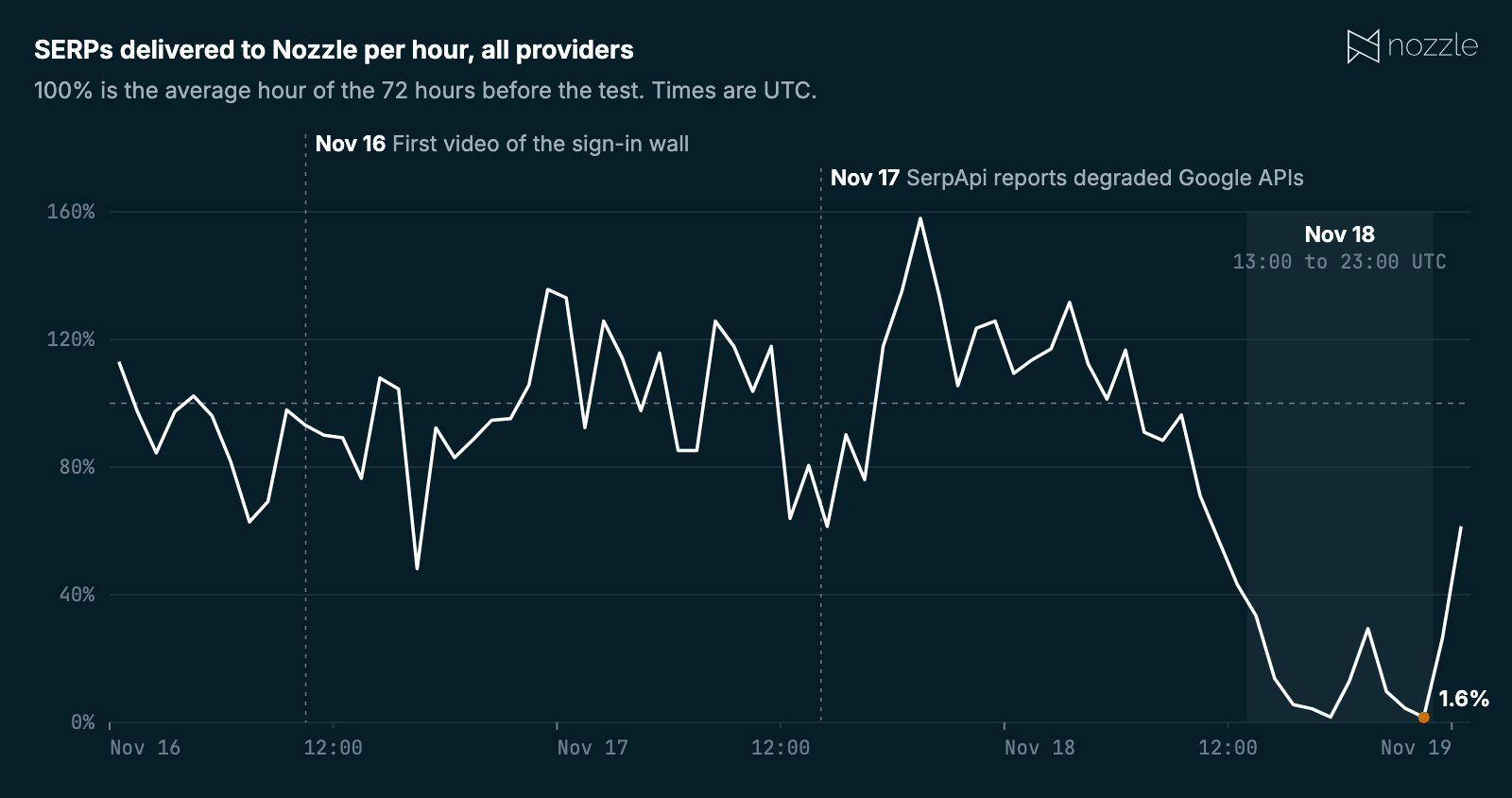
Deliveries started slipping late in the morning, UTC. From 13:00 to 23:00 UTC (8 AM to 6 PM ET) we received 11.6% of what ten normal hours bring in. In the two worst hours we received less than 2%.
It was not one provider. These are the five that were carrying our requests that day, each measured against its own normal:
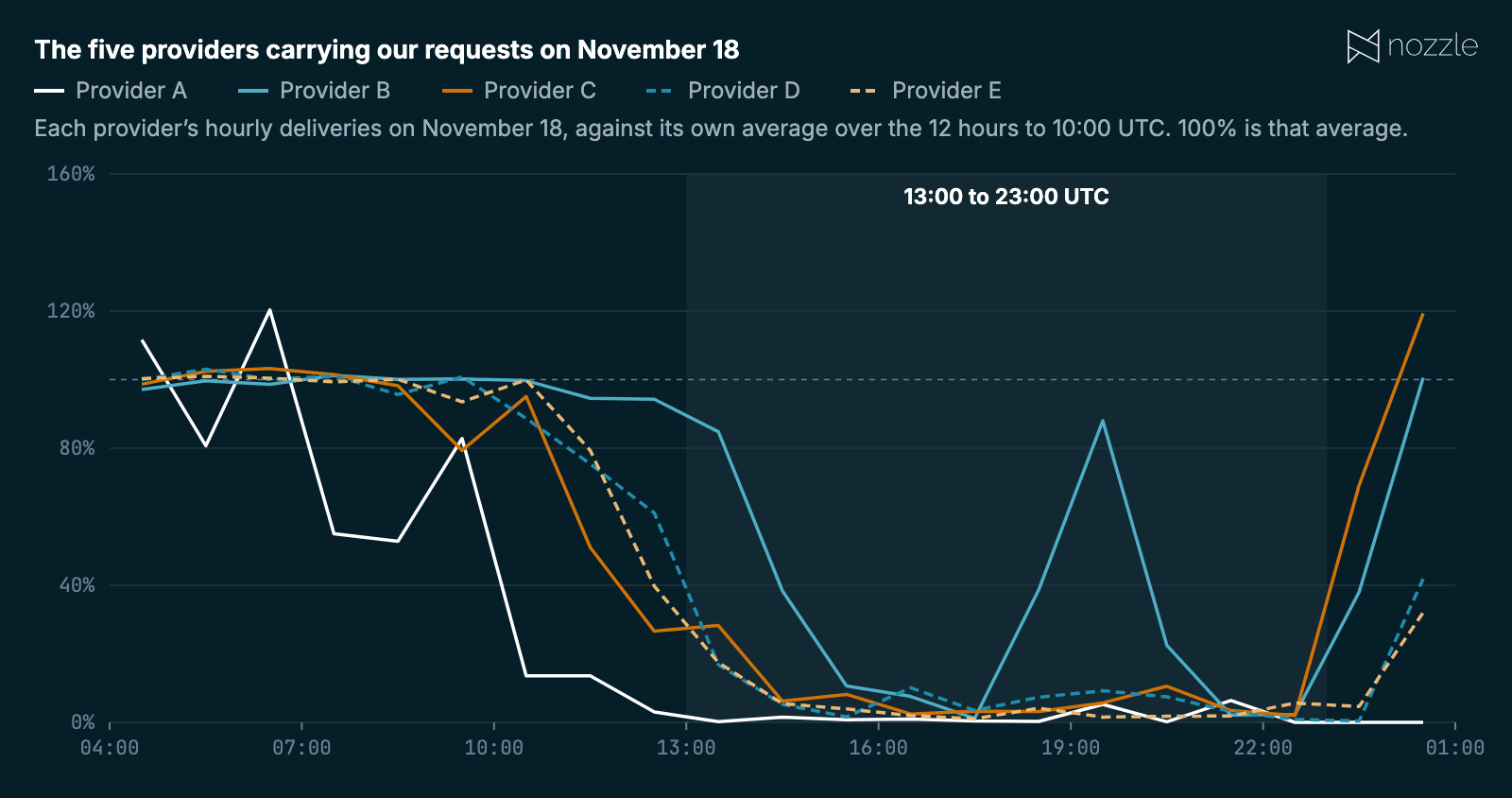
Every one of them fell to 2% or less of its normal rate in its worst hour. Over the ten hours, four of the five delivered under 8% of normal. The fifth managed about 30%, because it got back to nearly full speed for an hour around 19:00 UTC and was then knocked down again.
One of our providers shared that CAPTCHAs on its iPhone searches went from about 19% of requests to about 90%, and its requests kept landing on the two pages above.
Nearly every request met the delay. It holds each search for a few seconds, and at a scraper's volume, seconds are
money. That delay is in the same category as CAPTCHAs, /goto links and the end of num=100: each one makes a SERP
slower and more expensive to fetch, and none of them stops you.
The wall is a different kind of thing: there is nothing to wait out and nothing to solve. In one sample of that provider's blocked attempts, 31% ended on it and the rest on a CAPTCHA. Desktop searches were barely touched. What makes it even more insidious is that Google typically requires CAPTCHA solving first, then a login requirement after you've already paid to get there. It did not go away at 23:00 UTC: after the wave it was still showing up on a little under 1% of that provider's page loads.
How Google Rolls Out Changes
Google does not ship a change like this in one go. It steps it up, and it tells its own customers to do the same. Google's reliability engineers call the first step of a release a canary: a change put in front of part of the traffic for a limited time, then evaluated. Their advice to Google Cloud customers is to step from 1% to 10% to 100%, to watch the monitoring between steps, and to roll back early. Its page on how Search is tested says a live experiment goes to a small share of people first, "usually starting at 0.1%".
November 18 looks like one of those steps to me: a steep fall, a hard stop about ten hours later, and every provider hit. From the rollouts we have watched, the gap between a test like this and the real thing is anywhere from a few weeks to a few months. That is a small sample. If it holds and Google is willing to bear the risk of angering users and impacting revenue, the sign-in wall could come back to stay by the end of the year.
These are the rollouts I am comparing it to:
| Change | Early steps | Test at scale | Shipped |
|---|---|---|---|
/goto | About 1 to 2% from mid-June 2026 | About 10% from early August, one day at 100% | August 26, 2026 |
num=100 | Climbing in steps from late 2024 | A five-week step and a rollback, March to April 2025 | September 10–14, 2025 |
| Sign-in wall | August 2, 2026, after several pages | Ten hours on November 18 | Not yet |
/goto links
The /goto redirect links were
first reported in July. In our data they had
been on about 1 to 2% of SERPs since mid-June, after two brief tests in April and May. In early August they stepped up
to about 10%, with one day at 100%. On August 26 they went to nearly 100%, and
Google confirmed them the same day. This is the
chart I posted that day, with the steps marked:

The end of num=100
num=100 shows the other half of Google's advice, the rollback. This is the share of our num=100 requests that came
back with fewer results than we asked for, in four of the industries we track, from May 2024 to June 2025:

Look at early March 2025. All four lines step up on the same day, hold for about five weeks, and step back down on the
same day. Then the lower three step up again in May and in June. num=100 stopped working for everyone in
September 2025.
Ordinary SERP features
Google launches the features it wants you to notice the same way. The difference is that it announces each step.
| Feature | Opt-in test | Small share of traffic | Everyone in the US |
|---|---|---|---|
| AI Overviews | Search Labs, from May 2023 | March 2024 | May 14, 2024 (seven weeks later) |
| AI Mode | Search Labs, from March 2025 | May 1, 2025 | May 20, 2025 (nineteen days later) |
A limited test, a look at the results, then everyone. A change aimed at scrapers gets the same treatment, without the blog posts. Google is always running tests for other SERP feature changes and additions, and we see similar tiered rollouts of those.
Why Would Google Do This?
Is this about AI?
Mostly, yes. Google's real threat is not rank trackers. It is OpenAI, Anthropic and the other AI labs, whose assistants search the web before they answer, and Google's results are the best there are. Google turned down OpenAI's request for access to its index in 2024, and ChatGPT's real-time answers ran partly on Google results scraped by SerpApi, Search Engine Land reported. Google sued SerpApi in December 2025.
From Google's side, that is its index being distilled one query at a time by the companies building what is meant to
replace it. Blocking, /goto links and poisoned SERPs each made that more
expensive. A login is a different kind of answer, because an account is much harder to fake than a browser. Rank
trackers are caught in it because everyone who collects SERPs has to look like ordinary traffic.
Is Google measuring what a login would cost it?
That is my guess at what November 18 was for. A signed-out search still shows ads. If Google requires an account, some people will sign in and some will leave, and Google needs to know how many leave, and what they were worth, before it decides. Ten hours of forcing the question gives it that number.
The number may be small. If most of the signed-out searches that disappear behind a login come from rank trackers and scrapers, none of them was ever going to click an ad, and the change is close to revenue neutral. If that is what the test showed, I expect Google to require sign-in.
What else does Google gain from a login?
A lot. A signed-in search has a person attached to it, which means better data for ranking, for personalization and for ads. And someone signed in to Search is signed in to YouTube, Gmail, Maps and everything else Google runs. Google has every reason to want more signed-in users, and stopping scrapers gives it a reason to force the issue.
What could stop it?
Searchers and regulators. Plenty of people will not sign in to search, and some will go elsewhere first. A login wall on the default search engine would get regulators' attention. And Google's Rajan Patel said he does not believe the wall is meant to appear on the first page of results.
Is Rank Tracking Dead?
No. But it is going to get harder.
Collection gets harder
"Check it in incognito" is how SEOs look at a results page without their own history in it, and rank trackers collect
the same way, signed out. With a login in front of every search, there is always an account behind the results.
Collecting at scale would mean accounts, which Google can ban, and which carry their own personalization. There is the
pws=0 parameter to remove personalization, but using it at scale is likely to be a red flag.
APIs get less reliable
A blocked request fails loudly. A poisoned SERP does not: it comes back looking like any other results page, and nothing on it says the keyword's usual sites are missing. In our tests, most SERP APIs came back 50 to 60% poisoned on page 1, and some more than 90%.
Telling a poisoned SERP from a real ranking change takes history, because you have to know which sites a keyword usually returns before you can see that they are gone. Doing it well takes a lot more sophistication than parsing the page. Self-hosted and vibe-coded in-house trackers will struggle to keep their data consistent next to providers that have that history and people dedicated to data integrity.
Expect consolidation
Rank data that is harder and more expensive to collect leads to consolidation. JavaScript rendering, the end of
num=100, /goto links and poisoned SERPs each raised the cost of a SERP, and each was hardest on the smallest
players. A login wall would do it again. I expect fewer rank trackers and fewer SERP providers a year from now.
It is still solvable
The data is valuable, and more valuable now than it has ever been, which is exactly why everyone is trying to get it. Every change on that list looked like the end of rank tracking the week it landed, and none of them was. We will solve this one the way we solved those.
Timeline
Larger dots mark the turning points.
- Sep 10–14
num=100stops working, after months of tests in steps. The top 100 results now take ten requests instead of one.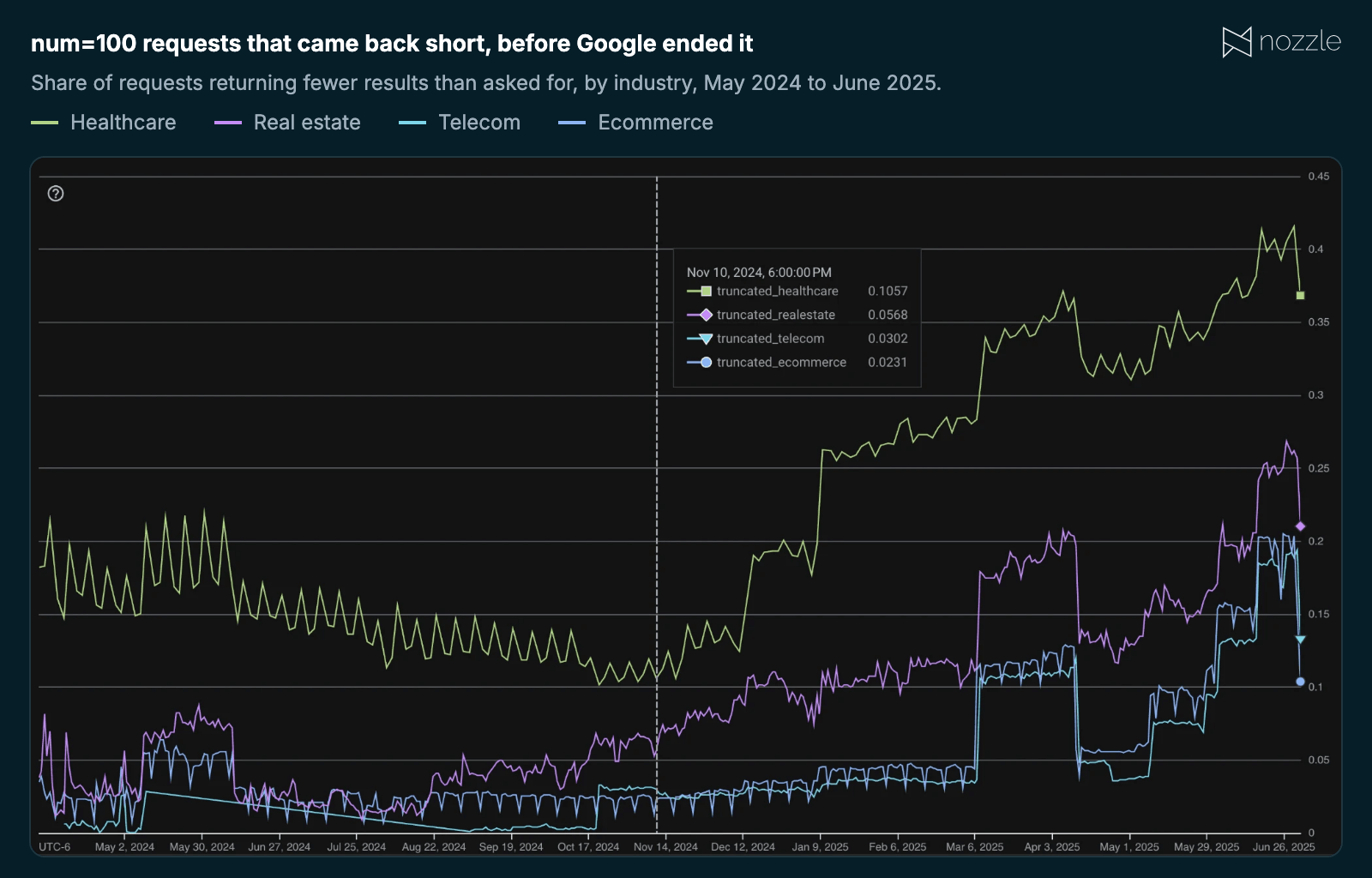
- Aug 2
"Sign in to continue" is first reported, in incognito, after paging past the first few results.
- Aug 26
/gotolinks reach nearly every SERP we fetch, after about 1% from mid-June and about 10% from early August. Google confirms them.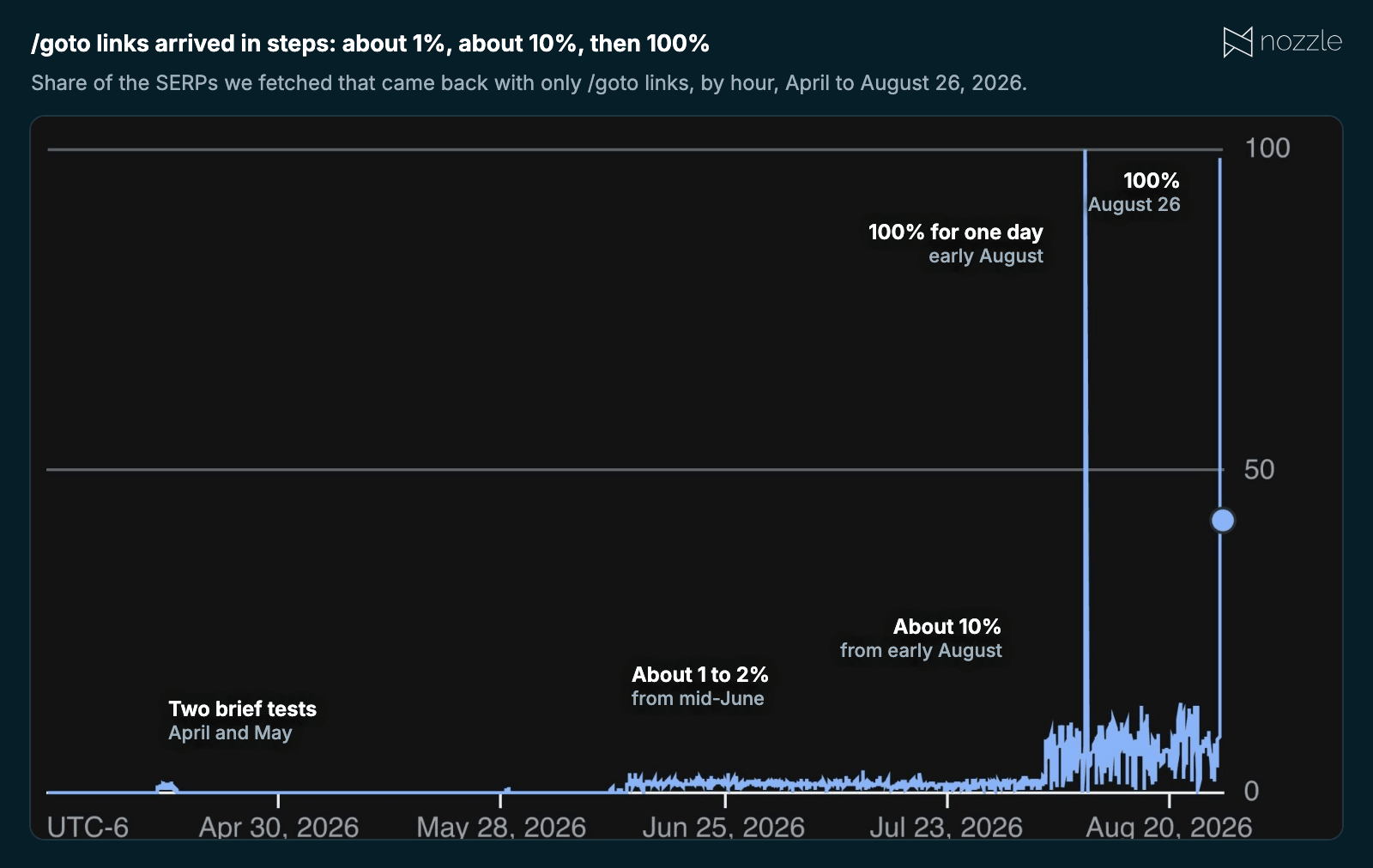
- Aug 31
"Verifying your request" is first reported: a wait of a few seconds before a search continues.
- Sep 13–20
Requests to Google start failing, and a week later Google starts answering with poisoned SERPs.
- Nov 16–17
Brodie Clark is made to sign in on his first search, in incognito. Google's Rajan Patel says "we may be testing something here".
- Nov 18
From 13:00 to 23:00 UTC, deliveries from all five providers we collect through collapse, and we receive 11.6% of our normal volume.
Next step
Connect the insight to the workflow.
See how Nozzle ties SERP monitoring, AI visibility, and competitive analysis together.
Explore pricing →